
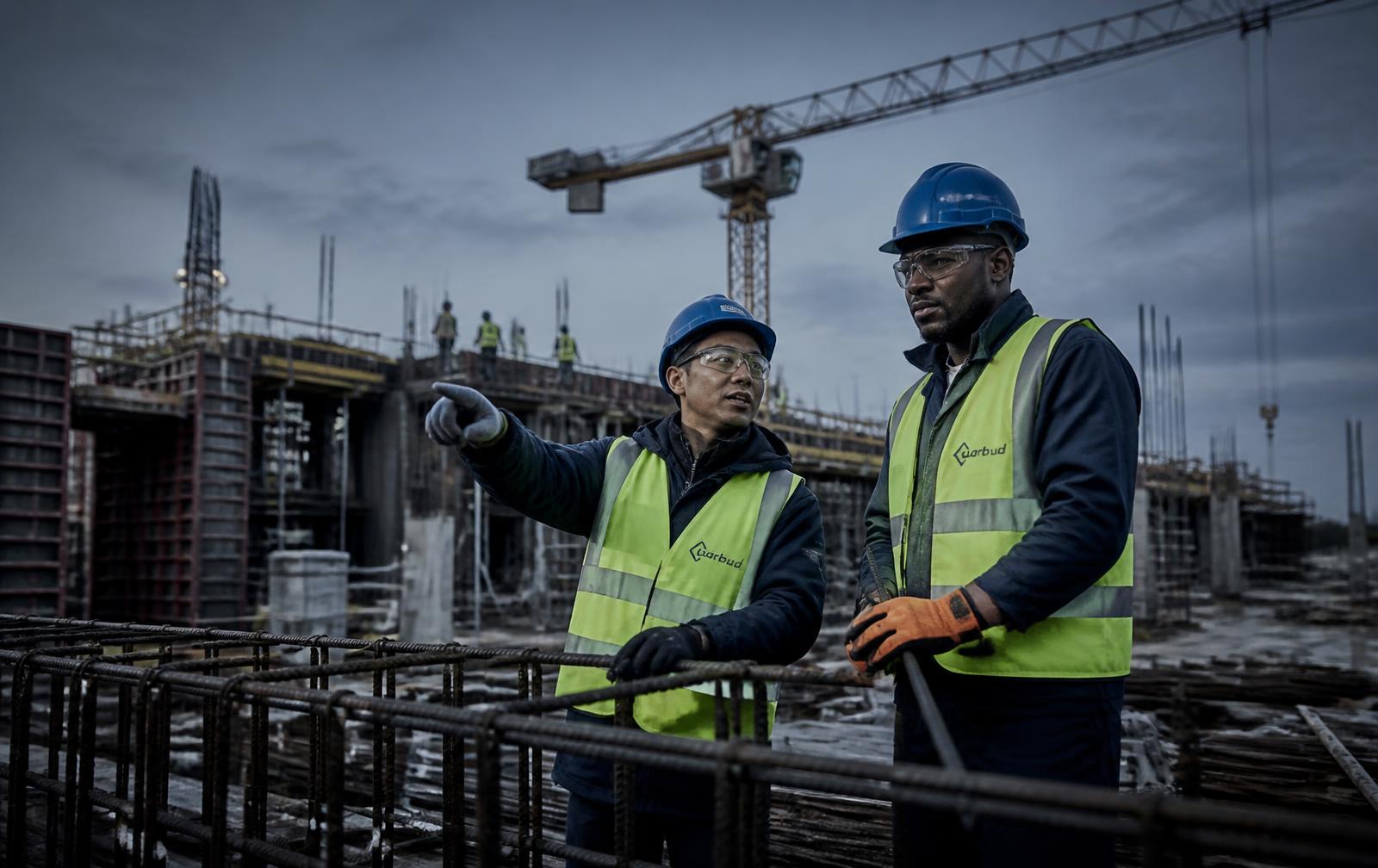
Construction workers from Asia and Africa
We recruit bricklayers, steel fixers, formwork carpenters, welders, machine operators and site labourers for general contractors and construction companies across Ukraine. We run the full path: trade-tested selection, document verification, topping up qualifications, accommodation near the site and onboarding within the crew.
- Structural, installation and general site roles
- Practical trade test before the candidate departs
- employment approvals, relocation, housing and transport to the site
- Direct recruitment, temporary work or crew outsourcing
- Scale
- from 5 to 300+ people
- Lead time
- 1–3 months
- Licences
- Welding · UDT · height
- Models
- Direct · TWA · outsourcing
- Guarantee
- Worker replacement
Ukrainian construction now recruits beyond Europe
Construction has not closed its staffing gap from the domestic and eastern markets for years, while infrastructure and housing investment grows faster than the number of tradespeople. Asian and African markets are no longer an emergency option – for many contractors they are planned, repeatable intakes.
5–300+
construction workers within a single contract
3–6 mo.
from contract to the crew entering the site
Trade test
bricklaying, steel fixing or welding before departure
8 markets
Philippines, India, Nepal, Bangladesh, Uzbekistan, Sri Lanka, Kenya, Morocco
Challenges contractors bring to us
No tradespeople on the domestic market
Bricklayers, steel fixers and formwork carpenters are shortage occupations. Contractors lose tenders not on price but on the inability to guarantee crews on time.
Contractual penalties for delay
The construction schedule will not wait for recruitment. Overseas sourcing has to start months before site entry, not after the first slippage.
Turnover between sites
Crews switch contractors mid-season over a few a modest pay difference. A group brought in for a contract stays longer because the agreement is planned in years, not months.
Inspection risk at the gate
Investors and site managers check documents on site. Gaps in verification can stop a work front mid-week.
Who we recruit for construction
Most projects concern the shell stage, but we staff installations, finishing and site support in parallel. Regulated trades follow a separate, slower selection path.
Bricklayers and plasterers
Load-bearing and partition walls, blocks, brick, silicate, machine and hand plastering, shell-stage finishing.
Steel fixers and concreters
Preparing and installing reinforcement, mesh and stirrups, pumps and vibrators, slab and foundation works.
Formwork carpenters
Wall and slab formwork systems, shuttering, timber structures and roof trusses.
Welders and steel erectors
MAG, TIG and stick welding, steel structures, halls, gantries and pipelines – certified or topped up in Ukraine.
Construction machine operators
Excavators, loaders, backhoes, rollers and mobile platforms – with UDT licences or obtaining them after arrival.
Plumbers and site electricians
Water, sewage, heating and gas installations, cabling, switchgear and installations on buildings under construction.
Paviours and scaffolders
Block paving, kerbs, site landscaping plus scaffolding assembly and dismantling under a certified foreman.
General labourers
Site preparation, material handling, crew support, keeping work fronts clear and demolition works.
Licences, medicals and safety on site
On a building site clearance to work is decided by documents and real skill, not by a declaration in a CV. That is why trade verification happens before departure and missing licences are added in parallel with document approval.
Trade and experience verification
We check references from previous sites, trade records and completed projects – especially experience from Middle Eastern and East Asian markets, where standards are close to European ones.
Practical test in the candidate's country
A section of wall, a reinforcement cage, a welded joint or a formwork element built against the clock, recorded on video and scored against your quality standards.
Welding certification
Existing certificates are verified and missing methods are added through an exam at a Ukrainian welding centre before clearance for load-bearing structures.
UDT machine licences
Operators are sent to a course and machine-operator exam in Ukraine; until the licence is issued they work in non-regulated roles.
Medicals and work at height
Medical checks, including height clearance, are arranged before work starts. Without them no worker steps onto scaffolding or a slab.
Safety training and workstation instruction
Initial training, instruction for the specific role and site movement rules – delivered in a language the worker understands.
The scope of licences is agreed on the role card – the path looks different for a steel fixer than for a structural welder or an excavator operator.
Three cooperation models for contractors
The model depends on how much HR responsibility you want to keep in-house. They can be combined – a core crew employed directly and seasonal peaks covered by temporary work.
Direct recruitment
The worker is employed directly by you. We handle selection, document verification, qualifications, arrival and the first weeks on site.
One-off recruitmentSelection built around site reality
A construction candidate has to meet criteria invisible in a CV: work pace, outdoor conditions and changing weather, safety discipline and working within a crew. The filter is agreed before the project starts and applied identically in every country.
Our recruitment filter
- Documented experience in the trade, not general labouring only
- Practical test on the target role, recorded on video
- Physical fitness and medical clearance, including work at height
- Communicative English and willingness to learn Ukrainian trade vocabulary
- Acceptance of shift work, outdoor conditions and changing weather
- Readiness to relocate between sites within the contract
What we agree on your side
- Role card: scope of work, quality standards and pace
- Required licences: welding, UDT, work at height
- Contract schedule and a realistic work front entry date
- Accommodation standard and distance from the site
- Who leads the crew and delivers workstation instruction
- Scope of video interviews between your site manager and candidates
Verification and employment compliance
Documents are the longest part of the schedule, so we handle them in parallel for the whole group rather than candidate by candidate. We work under our internal quality standards and contracts compliant with Ukrainian labour law.
Document and contract verification
Document checks, qualification verification and contract preparation handled for the whole group in parallel.
Relocation and entry
We compile relocation documents, book appointments and coordinate the group's flights and airport pickup.
onboarding documentation and legal stay
After arrival we run the temporary residence and employment approval application, registration of address and notifications to the authorities.
Documentation ready for site inspection
Worker file: approvals, medicals, safety training, UDT and welding certificates – ready for the investor and the site manager.
The first days on site
Whether a crew stays is decided in the first month. That is why onboarding is part of the project, not an add-on after arrival.
Day 0 – arrival and housing
Airport pickup, transport to accommodation near the site, SIM cards, first shopping and a starter briefing in the worker's language.
Week 1 – documents and safety
Medicals, initial safety training, workstation instruction, workwear and personal protective equipment, site passes.
Weeks 2–3 – working in the crew
Entering the work front under a foreman, matching pace and quality standards, ongoing correction and interpreter support.
Months 2–3 – stabilisation
Report for the contractor: output, quality, absence and safety events. A coordinator supports the workers with administrative and everyday matters.
How a project for a construction company runs
01 · Contract and work front analysis
We define the scope, construction schedule, required trades and licences, and a realistic site entry date.
02 · Profile and batch schedule
A role card with quality standards and a batch plan are created. Deadlines are counted backwards from the day people must be on site.
03 · Sourcing and trade tests
Parallel channels in two or three countries, one selection filter, trade tests and video interviews with your site manager.
04 · Verification and approval
Document verification, client approval and relocation planning handled in parallel for the whole group.
05 · Arrival and back office
Tickets, airport pickup, accommodation near the site, transport to the gate and protective equipment.
06 · Onboarding and care
Safety training, work in a crew with a mentor, a coordinator for the group, staffing reports and a replacement guarantee.
Where we source construction workers
The country is matched to the trade, language requirements, budget and deadline. On larger contracts we source in two or three countries at the same time.

Philippines
Excellent English and experience from major Middle Eastern contracts – welders, erectors and foremen.

India
The largest availability of bricklayers, steel fixers and finishing trades, with high candidate volumes.

Nepal
Endurance in physical work and a focus on long contracts, with strong results on structural works.

Bangladesh
Steel fixing, concreting and support works on volume and infrastructure projects.

Sri Lanka
Carpentry, finishing and installations, with high work discipline and low turnover.

Indonesia
Structural erectors and industrial facility works, with experience from Asian markets.
Risks we remove at the start
Construction projects fail for a handful of repeatable reasons. Each of them is addressed before the recruitment campaign is launched.
Worker without the required licence
UDT courses, welding exams and height medicals are booked before departure. Regulated work starts only once the document is issued.
Safety incidents in the first weeks
Workstation instruction in the worker's language, bilingual signage and procedures, and working in a crew with a mentor reduce the risk at the start.
Document tracking
A register of verified documents and medical checks kept up to date well in advance, so nothing lapses and site access is never blocked.
Disappointment with conditions after arrival
Rates, the work system, housing standard and overtime rules are presented before departure – this is the main reason for early departures from a site.
Frequently asked questions about construction workers
Which construction trades can you recruit?
Bricklayers, steel fixers, formwork carpenters, welders, structural steel erectors, heavy machine operators, plumbers, electricians, paviours, scaffolders, plasterers and general site labourers.
How long does it take from contract to the crew entering the site?
Realistically 1–3 months. Selection and document verification take 2–4 weeks, the verification and approval and relocation 1–3 months, and arrival with safety training and onboarding another 2–3 weeks. We run the stages in parallel for the whole group. Optional practical tests are a paid add-on on client request.
Are qualifications gained in Asia or Africa recognised in Ukraine?
Most construction trades require no formal recognition – experience and verifiable references decide. A practical test is available only as an optional paid add-on on client request. Regulated qualifications such as welding certificates, machine licences or electrical entitlements are topped up with training and exams in Ukraine.
How do you verify a bricklayer's or steel fixer's skills?
Beyond references and trade records we verify documents and employment history. A practical test in the candidate's country – a section of wall, a reinforcement cage or a formwork element recorded on video and scored against your quality standards – is available only as an optional paid add-on on client request.
Who handles health and safety training on site?
Initial safety training, workstation instruction and medical checks are arranged before the worker is cleared for work. Materials and instructions are delivered in the worker's language, and larger groups get a coordinator who translates on site.
Can the workers handle work at height?
Yes, although work at height requires separate medical clearance and training. Candidates declaring such work are sent for height medicals before departure, and scaffolding is erected only by certified personnel.
What language does the crew use with the site manager?
Communicative English plus basic Ukrainian trade vocabulary is the standard. From ten workers upwards we provide a foreman or coordinator speaking the workers' language, and drawings, instructions and procedures are prepared bilingually.
Do you arrange accommodation near the site?
Yes. We can take over the full back office: compliant accommodation, transport to the site, airport pickup and relocation between contracts – or invoice recruitment and document verification only.
What if a worker does not perform on site?
A replacement guarantee applies for the period written into the contract. More often we move the person to another position within the crew and send a new candidate for the demanding role.
Do you cover seasonal peaks and fixed-term contracts?
Yes. For seasonal work and hard deadlines we usually use temporary work or crew outsourcing – billing follows hours or scope, and employment and HR sit on our side.
Can we start with a smaller crew?
Yes, and we usually recommend it. A first batch of 5–10 workers lets you test accommodation, communication with the site manager and work pace before the full volume is launched.
Is hiring foreign workers on a construction site handled safely and transparently?
Yes, provided the documents are complete and current. We operate under our internal quality standards, keep a document register for every worker and track renewal deadlines so a check by the investor at the gate passes without findings.
We will complete the crews for your contract.
We reply within 48 hours with a recommended sourcing market, a batch schedule and a full cost-per-worker calculation – with no obligation.